


Botched melasma treatment is the term the P:LAB Medical Board uses for skin that has become more damaged after repeated incorrect melasma treatment: darker and wider melasma, white spots, a thin and red skin base, cream dependence, or all four at once. This is not severe melasma. It is melasma plus the consequences of incorrect treatment, and each type needs to be correctly named before anything else is done.
This section is medically reviewed by Colonel, Associate Professor, PhD, Senior Doctor, Meritorious Physician Phạm Hoàng Khâm, former Head of the Dermatology Department at Military Hospital 103, Chair of the P:LAB Medical Board. Updated: 02/10/2026.
What is botched melasma treatment?
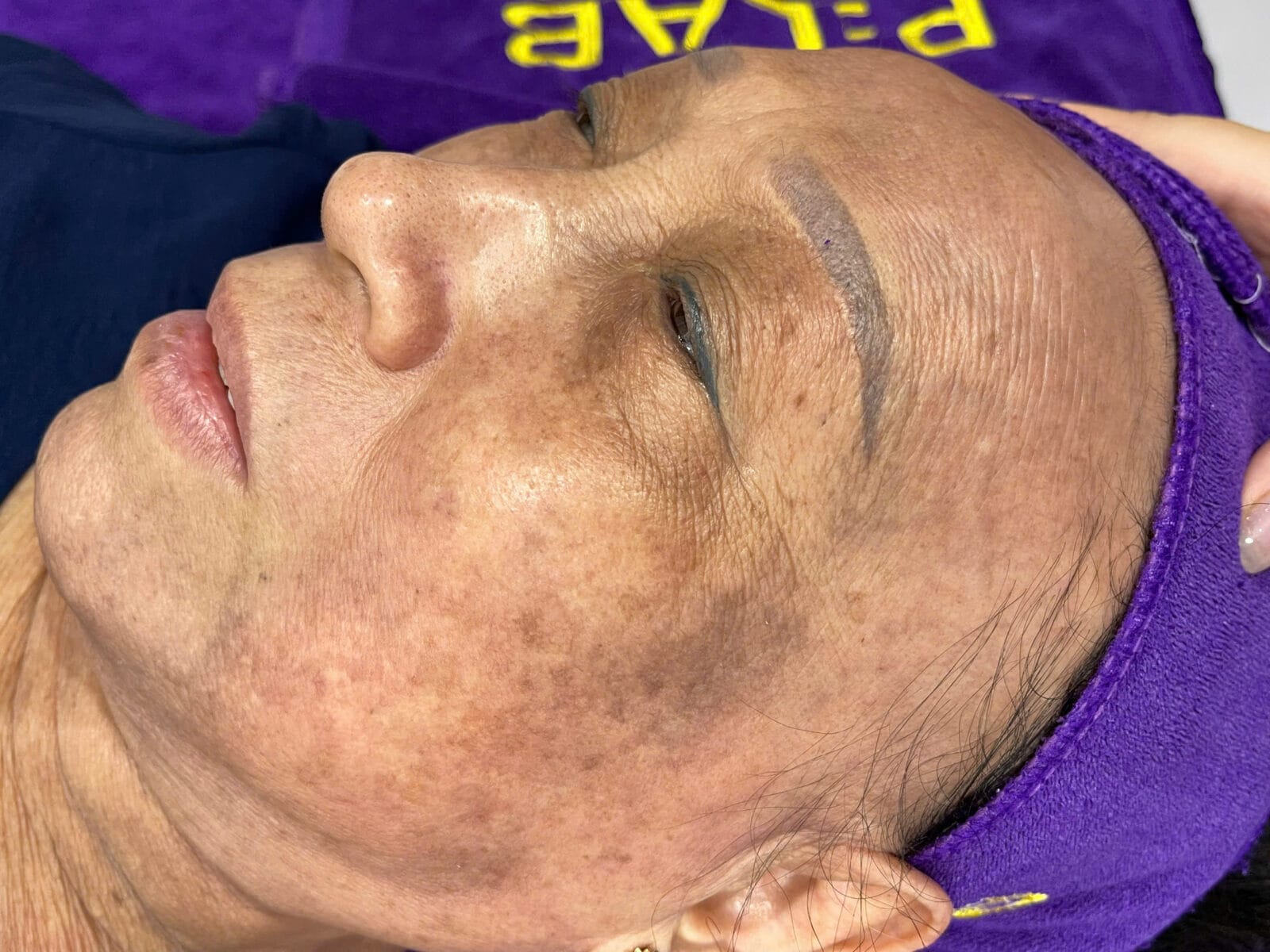
Botched melasma treatment (“thảm hoạ nám”, also spelt “thảm họa nám”) is the condition in which skin, after repeated incorrect melasma treatment, becomes more damaged than before treatment began: the original melasma remains, plus post-inflammatory hyperpigmentation, loss of pigment as white spots, a thin red skin base with dilated capillaries, or corticosteroid dependence from creams of unknown composition. The P:LAB Medical Board uses this term to distinguish it from “severe melasma”: severe melasma means a lot of pigment; botched melasma treatment is melasma plus the consequences of treatment, and it must be addressed in a different order.
Three quick signs: you have been treated at 2 or more places; your skin is now darker, redder or has white spots compared with before you started; and no clinic has examined your skin and told you which layer your melasma is in. If all three apply, you are in this group.
Why a dedicated section on “botched melasma treatment”
Most melasma content online is written for people who have never been treated: what melasma is, its causes, treatment methods. But a large share of clients at P:LAB are not at that starting point. They have been to 3-5 places, had laser, peels and creams, and their skin is now a combination of the original melasma, post-inflammatory hyperpigmentation, depigmentation, a weakened skin barrier and sometimes corticosteroid dependence.
For this group, the question is no longer “what treats melasma”. The question is: what type of damage the skin has, how severe it is, and in what order it should be treated. This section answers that question, one type at a time.
8 common types of botched melasma treatment
| # | Type of damage | Quick signs | Usually caused by | Detailed article |
|---|---|---|---|---|
| 1 | Darker melasma after laser (post-inflammatory hyperpigmentation) | Fades for a few weeks, then becomes darker and wider than before, with redness and stinging | Frequent, high-energy laser without assessing pigment depth | Darker melasma after laser |
| 2 | Depigmentation after laser | White dots or patches lighter than the surrounding skin in treated areas | Repeated laser over many months, “laser toning” every 1-2 weeks | White spots, depigmentation after laser |
| 3 | Pigment fireworks | White dots mixed with dark patches in the same area, mottled | Type 1 + type 2 at once, after many laser sessions | “Pigment fireworks” after laser |
| 4 | Thin, red skin, dilated capillaries | Constant redness, visible vessels, everything applied stings | Any repeated intervention: laser, peels, acids, corticosteroids | Thin, red skin with visible capillaries after melasma treatment |
| 5 | Corticosteroid-damaged skin | Brightens quickly at first; flares red when the cream is stopped; calms when reapplied | “Fast whitening” creams of unknown composition | Corticosteroid-damaged skin from melasma creams |
| 6 | Darkening after peels | Still patchy and dark after peeling, or brighter for a few days then darker | High-concentration peels, repeated frequently, on weakened skin | Patchy darkening after chemical peels for melasma |
| 7 | Melasma spreading after stopping cream (rebound) | 1-4 weeks after stopping, melasma is wider and greyer than before, with redness | Artificial pigment suppression with corticosteroids, uncontrolled hydroquinone | Melasma spreads after stopping cream |
| 8 | Mixed melasma treated as superficial melasma | Responds in the first sessions, then stalls; labelled “deep-rooted” or “treatment-resistant” | No skin analysis or Wood's lamp before choosing a method | Mixed melasma, deep-rooted melasma |
These eight types rarely occur alone. A typical case at P:LAB has 2-4 types overlapping: original mixed melasma, laser-induced post-inflammatory hyperpigmentation, a corticosteroid-damaged skin base, and a few depigmented dots. Each type needs its own approach and, more importantly, a sequence.
Three commonly misused terms
“Treatment-resistant melasma” - strictly means melasma that does not respond despite correct treatment for long enough. Most cases self-described as “resistant” have never had their pigment depth diagnosed, so the “resistance” lies in the treatment history, not in the person's constitution. → What is treatment-resistant melasma
“Recurrent melasma” - one name for three different situations: genuine melasma returning because its triggers are still present; a deeper component that was never treated now showing through; or post-inflammatory hyperpigmentation caused by a course of treatment. → Melasma recurring after 3-6 months
“Melasma” - when it is actually freckles, age spots, post-inflammatory hyperpigmentation, or a mix of all four on one face. Misnaming is the first wrong step, and treating melasma as freckles is the shortest route to types 1-3. → Telling apart melasma, freckles, age spots and post-inflammatory hyperpigmentation
Causes of botched melasma treatment: three steps that get skipped
Looking across all 8 types, the same root causes recur in almost every case:
- Pigment depth not determined before choosing a method, so mixed melasma is lasered like superficial melasma, and lasered harder when it does not respond.
- Skin base not assessed before intervention, so laser and peels are applied to inflamed or corticosteroid-damaged skin, and each intervention produces more pigment.
- No measurement, so “improvement” and “getting worse” are both just impressions, and when the client's impression differs from the consultant's, the client is told to persevere.
These three steps are the first three principles in the 5 treatment principles of the P:LAB Medical Board. Why they are skipped at so many places is analysed in the “Why Treatments Fail” series, starting with 5 common denominators of melasma cases that did not clear after treatment at many places.
Recovery from botched melasma treatment: the right order, no skipped stages
Each type has its own detailed article, but every treatment protocol for botched melasma treatment at P:LAB follows the same sequence:
| Stage | What we do | What we don't do |
|---|---|---|
| 1. Diagnosis | Skin analysis, Wood's lamp, standardised photos, MASI score, review of history and current products; case conference; mapping of pigmentation and the level of skin base damage | Treating anything at the first visit |
| 2. Stop and withdraw | Stop laser, peels and acids; planned corticosteroid withdrawal if needed | Stopping a long-used cream abruptly on your own |
| 3. Restore the skin base | Rebuild the barrier, reduce inflammation and redness, strict sun protection; exosome support where indicated; treat capillaries if needed | Touching the pigment while the skin is still inflamed |
| 4. Treat pigment by layer | Suitable active ingredients for the superficial component; low-energy technology, multiple sessions, sufficiently long intervals for the deep component | Aggressive, frequent laser, one formula for the whole face |
| 5. Measure, maintain, follow up | Re-measure MASI at 30-60-90 days; maintenance plan; follow-up visits at 3-6-12 months | Ending the treatment course means stopping everything |
The treatment protocol is set by Assoc. Prof. Dr. Phạm Hoàng Khâm together with the Medical Board; it is carried out by Dr. Thiên (Specialist Level I doctor Hoàng Thanh Thiên), Medical Director of P:LAB. With botched melasma treatment, separating these two roles is mandatory: the person deciding whether to stop or continue cannot be the person under pressure to sell treatment courses. All timelines are set out in the 90-Day Journey; the achievable level of improvement is stated clearly in advance and recorded in the written commitment for eligible cases.
Where to start
- If you want to know what level you are at: 10-question self-assessment - 5 minutes, tells you whether you need to stop now and what to bring to your consultation.
- If you want to see the typical journey of someone in the same situation: Profile of a botched melasma treatment client: 5 clinics, 3 years.
- If you have already recognised your type: read the detailed article in the 8-type table above.
- If you want to see real results: Client stories at P:LAB.
All articles in this section
Identifying each type
- “Pigment fireworks” after laser: what mottled white and dark skin really is
- Darker melasma after laser: it is post-inflammatory hyperpigmentation, not “melasma flaring”
- White spots, depigmentation after laser: what level can still recover
- Thin, red skin with visible capillaries after melasma treatment: the skin barrier has broken down
- Corticosteroid-damaged skin from melasma creams: 6 signs
- Patchy darkening after chemical peels for melasma
- Melasma spreads after stopping cream: the “rebound” effect
- Mixed melasma, deep-rooted melasma: the type most often mistreated
Three commonly misused terms
- What is treatment-resistant melasma: why “resistance” usually comes from treatment, not constitution
- Melasma recurring after 3-6 months: true recurrence, or never treated correctly
- Melasma, freckles, age spots, post-inflammatory hyperpigmentation: telling them apart to avoid mistreatment
Tools and profiles
- Preliminary at-home self-assessment of skin damage (10 questions)
- Profile of a botched melasma treatment client: 5 clinics, 3 years, and a question no one has answered
Why Treatments Fail - a series critiquing the market, being updated: 5 common denominators of melasma cases that did not clear after treatment at many places
Press coverage of botched melasma treatment at P:LAB
Eva.vn (19/08/2026): A reputable, safe and highly specialised clinic for treating botched melasma: introduces P:LAB as a clinic specialising in botched melasma treatment cases, led by the Medical Board chaired by Assoc. Prof. Dr. Phạm Hoàng Khâm.
Darker, redder skin or white spots after repeated melasma treatment? Send photos for the P:LAB Medical Board to give a preliminary assessment before you undergo any further treatment course.
Frequently asked questions
What is botched melasma treatment?
It is skin that has become more damaged after repeated incorrect melasma treatment: the original melasma remains, along with post-inflammatory hyperpigmentation, depigmentation, a thin red skin base or corticosteroid damage. It differs from severe melasma in that the skin base must be restored before the pigment is touched.
Is botched melasma treatment the same as severe melasma?
No. Severe melasma is melasma with a lot of pigment. Botched melasma treatment is melasma plus damage from incorrect treatment: post-inflammatory hyperpigmentation, depigmentation, a damaged skin base, cream dependence.
Can botched melasma treatment be treated?
Most cases can be improved if the right order is followed: diagnosis, stopping interventions, restoring the skin base, and only then treating pigment by layer. Some damage, such as severe depigmentation, is difficult to recover fully; the Medical Board explains this clearly before starting.
What should I do straight away if I have botched melasma treatment?
Stop laser, peels and acids. Do not abruptly stop a cream you have used for a long time on your own if you suspect it contains corticosteroids; ask a doctor first. Use strict sun protection, take baseline photos, and bring the products you are using and your previous treatment records to your consultation.
How long does treatment of botched melasma take?
The skin base recovery stage usually takes about 30 days, longer in some cases. The whole programme is tracked at 30-60-90 day milestones, followed by maintenance and follow-up visits at months 3, 6 and 12.
Who treats botched melasma at P:LAB?
Assoc. Prof. Dr. Phạm Hoàng Khâm chairs the case conference and signs off the treatment protocol; Dr. Thiên (Specialist Level I doctor Hoàng Thanh Thiên), Medical Director of P:LAB, carries it out directly. P:LAB has 2 clinics: 88 Mễ Trì Hạ, Từ Liêm Ward, Hanoi (Operating Licence No. 4290/HNO-GPHĐ) and 402 An Dương Vương, Chợ Quán Ward, Ho Chi Minh City (Operating Licence No. 01725/HCM-GPHĐ).